



I think that aramid’s biggest advantages are resistance to high temperatures, flexibility, lifespan of the panels, resistance against mechanical stress and easy processing into end products
says Pawel Majkowski, the application solution manager at Teijin Aramid, the largest producer of aramid fibers in the world. In the exclusive interview with the BodyArmorNews.com during the 33rd International Defence Industry Exhibition MSPO in Kielce, we talked about aramids versus polyethylene, sustainability that is not greenwashing, and growing demand for aramid products.
The overall atmosphere in Kielce this year seemed to reflect the rapidly growing interest in defence in Poland. The exhibition has been visited by nearly 40 000 people, including over 800 exhibitors and 170 delegations from 42 countries. At their booth, Teijin Aramid had one main goal, to respond to the growing demand for ballistic solutions in the region and convince the visitors that their yarns are not just optimal for mass production but also better than other competing raw materials.
Are Aramids Really Better?
From tires and brake pads to submarine communication cables, and finally, body armor – aramids have been known for their numerous properties. However, as admits Majkowski, in the body armor industry, where manufacturers are racing to create the lightest product without compromising its level of protection, there has been another strong player:
Our main competition; In body armor it’s UHMPW-PE and we appreciate the pros of that material. It has a number of advantages, but like every product, it has its cons too.
Everything starts already at production – aramids’ high heat resistance allows for use of types of resins that are being processed in high temperatures; for instance, the standard, very common phenolic based thermoset resin.
That means two things; firstly, this property of aramids allows processing material at highly elevated temperature and by that shorten the processing time – for example Twaron® based helmet shells or vehicle panels can be pressed in under 20 min and removed from the press mold at increased temperature without having to cool while maintaining press pressure. That’s a significant difference in comparison to polyethylene, which utilizes a thermoplastic resin matrix, usually takes over an hour.
Secondly, resins that are processed in higher temperatures are less sensitive to the outside heat, a handy feature in case of materials used in vehicles in hot climates.
For example, if there is a vehicle sitting in a 40 degree heat outside, the temperature of the car, in the doors or roof within the body where the car armouring panels are placed, might reach in excess of 100 degrees Celsius. If the resin used in the panel is a thermoset or thermoplastic with a melting point above 150 degrees, the outside temperatures have little to no impact on panels’ properties. UHMWPE yarn on the other hand is sensitive for elevated temperatures above 130 degrees and can only be combined with the resins that can be processed at relatively low temperatures compared to aramid. For example the softening point of LDPE resin may be as low as 85-90 degrees. This has an obvious impact on the interlaminar adhesion of the panel layers and stability of the panel performance under severe conditions, says Majkowski.
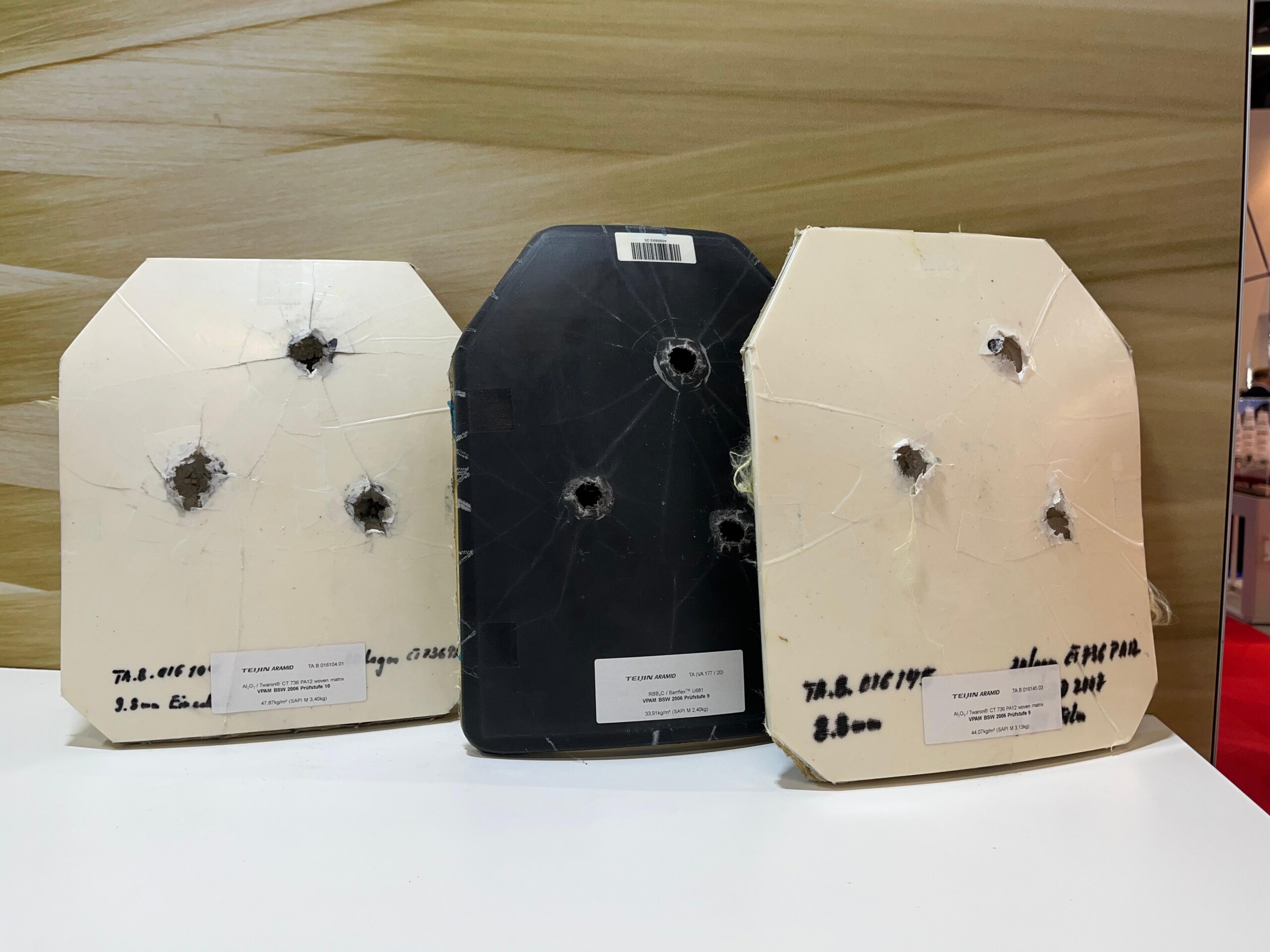
Once aramid panels leave the supplier’s production line, it is time to undergo testing. Twaron® has shown consistent performance, even after tumbling (imparting mechanical stress), a part of NIJ testing where ballistic panels are placed in a rotational tumbler for 10 days and subjected to 72,000 cycles of 65°C heat and 80% humidity to simulate prolonged use and exposure to environmental and mechanical stress. As it turns out, Twaron® fibers, especially when used in woven fabrics, maintain their original performance capability more effectively than most UHMWPE UD’s. That means, aramid yarns remain durable for years, lengthening materials’ warranty period.
If we have the option of using materials that are more resistant to mechanical stress and aging, we can actually save money rather than increase expenses. Even if such a material is initially more expensive to purchase, being able to use it for longer over its entire life cycle ultimately reduces costs. This will only become more important, because if Poland, for example, expands its army from 60,000 a few years ago to 300,000 now, and possibly even more in the future, this creates a recurring cost in the budget. So, the longer these vests can be used, the better it is for the budget.
Besides heat resistance, durability and easy processing, aramids still have some more properties worth mentioning.
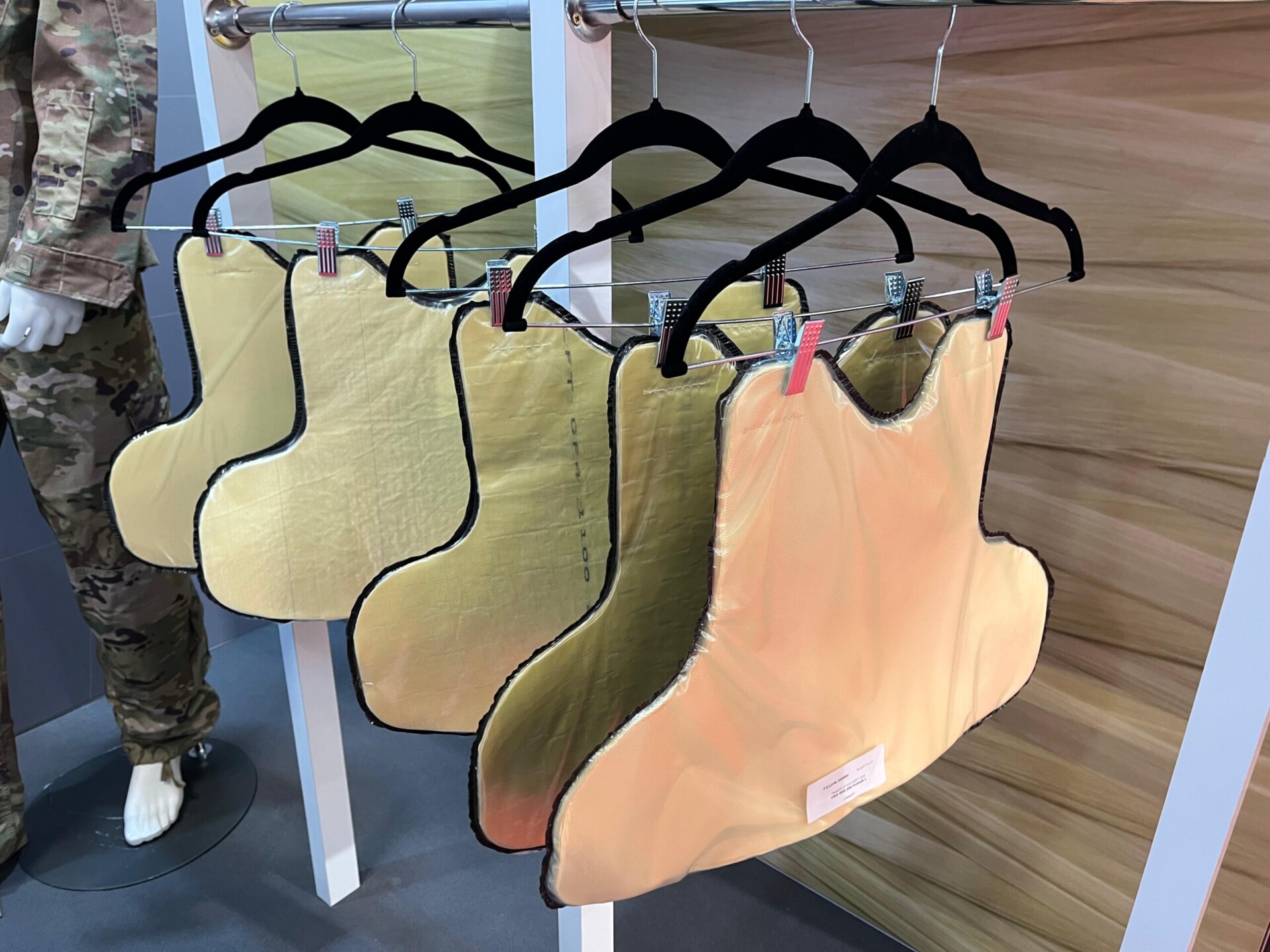
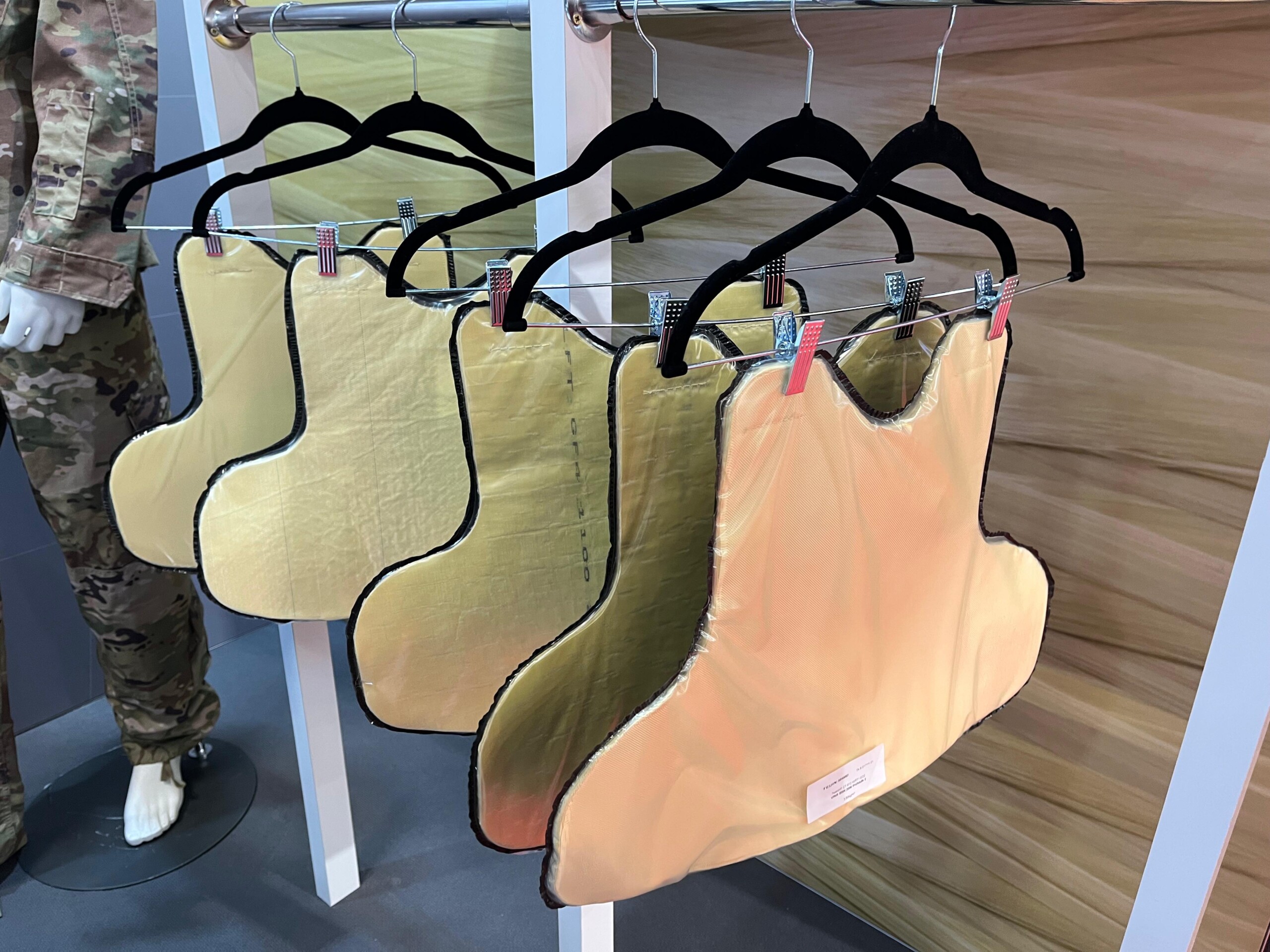
A huge advantage of Twaron® aramid, and in my opinion one of the biggest, is that it is very flexible in woven fabric constructions, Majkowski demonstrates Twaron® fabric flexibility by grasping the aramid panel in his hand and crumbling the material in his fist. In a sector where body armor manufacturers compete to deliver vests that maximize mobility without compromising protection, flexibility becomes a key advantage and often a decisive factor in selecting a material supplier. As Majkowski admits, solutions made of UHMWPE UD’s in some cases can indeed be lighter, but also more stiff due to its manufacturing technique.
This difference in weight may seem insignificant in comparison to the entire uniform and soldier’s equipment load, but, there might be a significant improvement in comfort and mobility using woven aramid, thereby enhancing overall safety, says Majkowski.
This issue of real protection becomes even more clear when looking at ballistic performance requirements such as the V50 test, which measures the velocity at which a projectile has a 50% chance of perforating the armor. While UHMWPE often demonstrate very high V50 values, this can be misleading because the material also tends to produce a broader zone of mixed results. Twaron® aramid, by contrast, show a much steeper performance curve. This ensures that its protective qualities remain consistent and predictable, providing a higher degree of real-world safety. For Majkowski, this consistency is one of the strongest arguments of Twaron® aramid, proving that even if aramid systems may be slightly heavier, they deliver security where it matters most.
Innovation Towards More Sustainable Future
Both polyethylene and aramids are some of the most widely used materials in modern body armor, each offering distinct advantages as well as limitations. UHMWPE is prized for being lightweight, though it can be more rigid potentially restricting mobility and suffer reduced performance at high temperatures. Aramids, such as Twaron® are known for their excellent strength, flexibility, and ability to withstand repeated impacts, but tend to be slightly heavier. Ultimately, the choice between materials often depends on the trade-off balance of weight comfort, flexibility/mobility, durability and long-term resilience. But Teijin Aramid has one more card in its pocket, and that is sustainability.
Recycling old vests by mechanically grinding the aramid fibers into a pulp for use in aftermarket brake pads and other friction applications has been a popular sustainable practice for years. Recently, Teijin Aramid took this a step further by starting physical recycling of aramid.
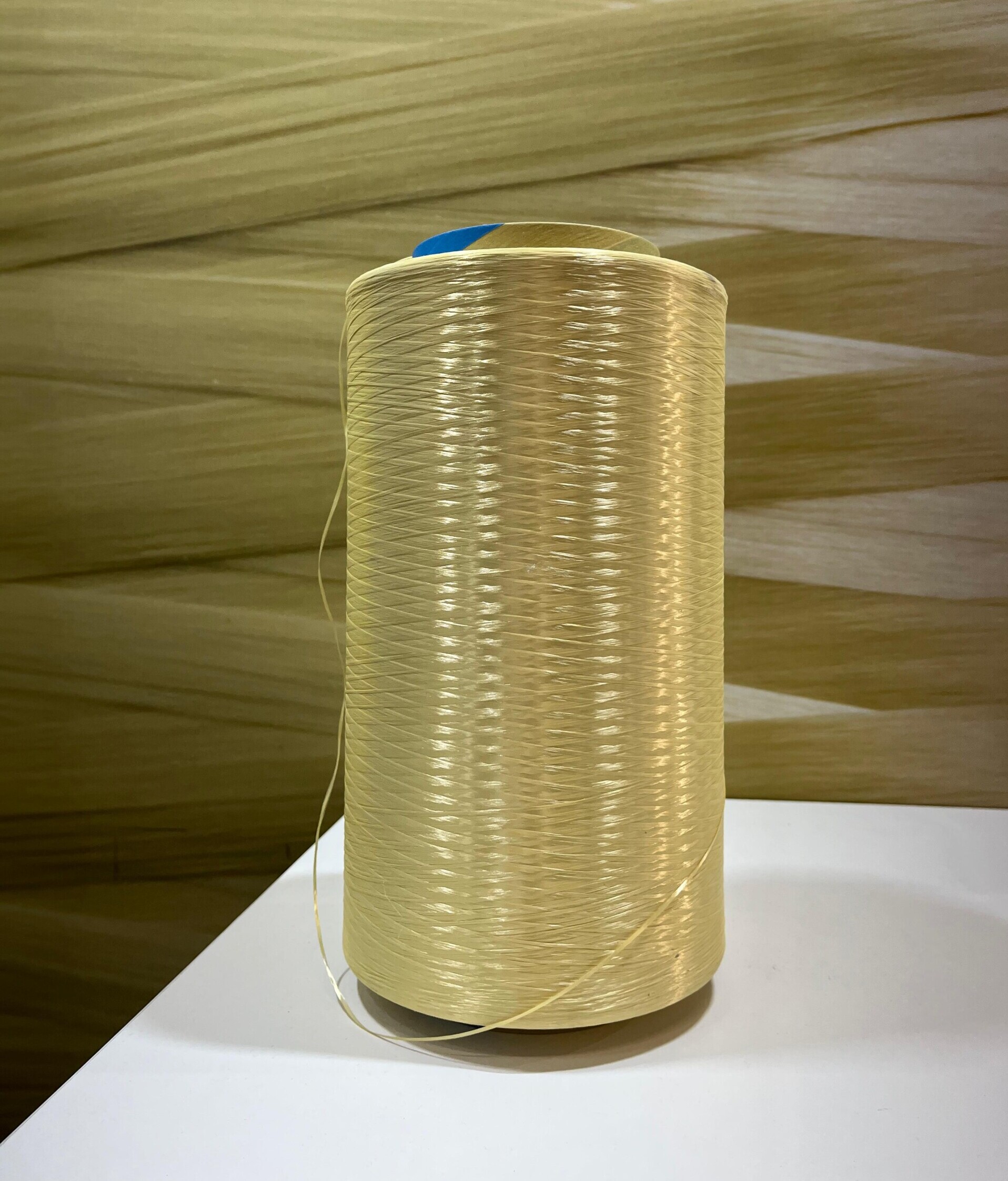
We can redissolve the pre consumer aramid materials (f.e. production waste) back to polymer form without impacting the chemical structure. From this raw material, we can spin a new yarn. We call this Twaron Next®. The product will have the same properties and the same parameters as standard Twaron® , but with a lower carbon footprint.
As Majkowski claims, the process can be repeated several times, and currently, Teijin Aramid is the only company in the world that has achieved this feat. The innovation however, does not stop there.
Aramids are generally vulnerable to water, which poses a challenge for ballistic vests that must remain resistant to water. To ensure their reliability, these vests undergo immersion tests with various fluids, and the fabrics used in their production are typically treated with a water repellent finish to protect the fibers. The most common method has long involved the application of fluorine-based treatments, but this approach is both hazardous and environmentally harmful. Currently, Teijin Aramid is likely the only brand worldwide to have developed an alternative, introducing a patented formulation that effectively provides water repellence to Twaron® fiber based fabrics without relying on the use of fluorine or PFAS containing toxic substances.
Aramids in Practice
At a time when security challenges are growing and the demand for reliable protection is higher than ever, the choices made in materials science carry real consequences. The conversations in Kielce this year made one thing clear: innovation in defence is not just about lighter or stronger products, but about smarter, more responsible solutions. And in that race, aramids such as Twaron® continue to prove that they are more than just fibers.
According to experts, the greatest threat on the battlefield today is not small arms, but fragments caused by explosions. When a projectile falls and explodes, it produces a blast and countless fragments of different sizes and trajectories.
As Majkowski points out, there is no sense in designing solutions, for example helmets, at the level of one thousand meters per second. If someone is that close to the explosion, he will be killed either by the blast itself or by the number of fragments, because the fragments will have different sizes and go everywhere.
In reality, soldiers only have a chance of survival at a certain distance from the blast, where fragments travel at several hundred meters per second, not at 1000 meters per second. This is why designing helmets optimized for realistic velocities, around 670–700 meters per second V50, is more meaningful than creating overly light but fragile designs that might look impressive on paper but compromise actual protection. Another challenge is durability in real conditions.
We know perfectly well that soldiers, even if they are the best trained and the best educated, at some point will sit on their helmets. If a person is tired after a whole day of work, even during training, leaving aside the situation on the front line, this product cannot be delicate. If it is too delicate, then it is simply not functional for the soldier.
Ultra-thin shells may pass laboratory tests but fail under compression in the field, making them impractical for everyday soldier use. As Majkowski summarizes, the point is not to compete for unrealistic V50 levels like 1000 meters per second, which are more of a marketing number than a true measure of safety.
It looks beautiful, but it gives nothing, to make the soldier safer.
Instead, solutions should be optimized where it makes sense, balancing weight, durability, and real-world ballistic performance, an area where Twaron® continues to meet the demands of modern warfare.
At the end of the day, the true measure of a ballistic material is not what it promises on paper but how it performs when lives are at risk. In this respect, aramids such as Twaron® continue to deliver, not only in their protective qualities but also a more sustainable future for defence.