

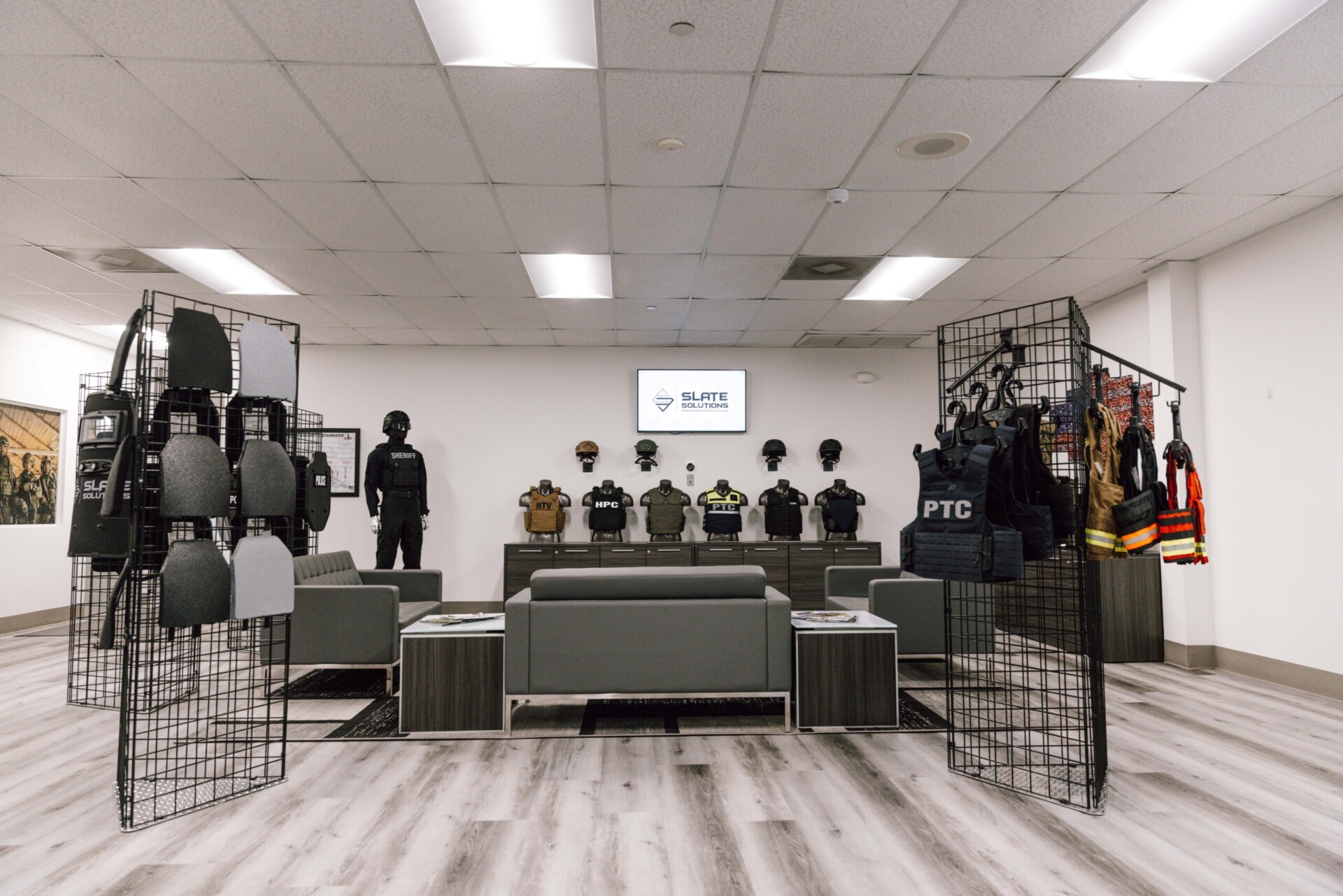


As operational lessons from recent conflicts continue to reshape requirements for personal protection, U.S.-based manufacturer Slate Solutions is focusing its development efforts on modular armor, fragmentation coverage, and rapid product development.
At Milipol Paris, BodyArmorNews spoke with Slate Solutions CEO Mike Slate and President Andy Schneurer as the company introduced new soft and hard modular armor systems for law enforcement and military users across Europe.
New Product Introductions at Milipol
At this year’s exhibition, Slate Solutions showcased several new platforms, including high-visibility soft body armor solutions, new hard armor products, and an expanded helmet lineup. Among the most notable introductions was the G-Fold, a foldable Level IIIA ballistic shield making its first appearance in France.
The company also unveiled two new helmets: the Kura, a rifle-rated ballistic helmet, and the Volta, rated to VPAM standards. In addition, Slate presented a ballistic tactical shirt, a garment integrating sewn-in soft armor, designed specifically to mitigate fragmentation threats.
Fragmentation Drives Design Priorities
According to Slate Solutions, recent battlefield data, particularly from the conflict in Ukraine, has reinforced the need to rethink how coverage is delivered. Company leadership cited estimates suggesting that as many as 85 percent of combat injuries are caused by fragmentation and shrapnel rather than direct ballistic impact.
This shift has informed Slate’s approach to armor design, emphasizing expanded coverage areas and lightweight solutions that can be worn in conjunction with traditional plate carriers. The ballistic tactical shirt is one example of this philosophy, providing additional fragment protection as a wearable layer rather than a rigid system.
Operational Experience and Support to Ukraine
Slate Solutions has contributed to international support efforts for Ukraine through a partner organization, supplying between 25,000 and 35,000 ballistic vests under a training-related program. While the company declined to discuss operational details, leadership described the effort as indirect government support rather than a direct supply arrangement.
The experience has further shaped Slate’s understanding of real-world armor performance and end-user needs, particularly in high-fragmentation environments.
Modularity and User-Driven Design
Modularity remains a central design principle across much of Slate’s armor portfolio. Many of the company’s vest systems are built around a base configuration that can be expanded with add-on components, including throat, collar, bicep, groin, and neck protection. This approach allows users to tailor protection levels based on mission requirements without replacing entire systems.
Slate emphasizes continuous collaboration with end users throughout the product development process. New designs are routinely evaluated by operational personnel, with user feedback incorporated before final production decisions are made.
Female-Specific Armor and Advanced Ceramics
Among the systems on display were female-specific armor solutions, including a dedicated hard armor plate designed to better match female anatomy. Slate also noted the use of 3D-printed ceramic tiles in select female armor systems, enabling more complex geometries and improved fit while supporting weight reduction and multi-hit performance.
More broadly, the company acknowledged incremental advances in ceramic processing technologies across the industry, contributing to modest weight reductions and improved ballistic efficiency.
Manufacturing, Sourcing, and Sustainability
Slate Solutions is headquartered in the United States and sources approximately 90 percent of its materials domestically, with the remainder sourced globally as needed. The company highlighted its ability to balance small-batch custom production with higher-volume standardized manufacturing, a flexibility it attributes to its relatively small and agile organizational structure.
Sustainability considerations are integrated into Slate’s production processes, including extensive recycling of raw materials, energy-efficient facility systems, and efforts to minimize landfill waste. Operating out of South Florida, the company has invested in modern HVAC systems, lighting automation, and energy-conscious material handling equipment to manage both environmental impact and operating costs.
Expanding into the European Market
Slate’s presence at Milipol reflects a broader effort to expand into the European market through partnerships with regional dealers and distributors. While the company’s core customer base remains law enforcement and military users, Europe represents a key growth area as agencies reassess protection requirements in response to evolving threat environments.
By combining modular armor systems, fragmentation-focused design, and direct engagement with end users, Slate Solutions is positioning itself as a responsive supplier in a market increasingly shaped by operational feedback rather than legacy assumptions.