


At EnforceTac 2026, UK-headquartered NP Aerospace presented what may be one of the most comprehensive female-specific armor solutions currently under development. With nearly a century of heritage behind it, the company is now applying its composite expertise to address a long-standing capability gap in personal protection. BodyArmorNews had the pleasure of speaking with Erin Grieve, Sales Manager, and Seren White, Senior Project Engineer, about the advancements with female plates.
The company operates across two primary segments: composite armor systems, including bomb suits, body armor and helmet shells, and vehicle programs, ranging from UK Ministry of Defence upgrades to civilian armored vehicle supply. Their focus at EnforceTac was firmly on personal protection.
Moving Beyond “Adjusted” Male Plates
Female-specific armor is often approached through minor modifications to male templates, an approach which can be uncomfortable at best and life-threatening at worst. NP Aerospace has taken a fundamentally different route.
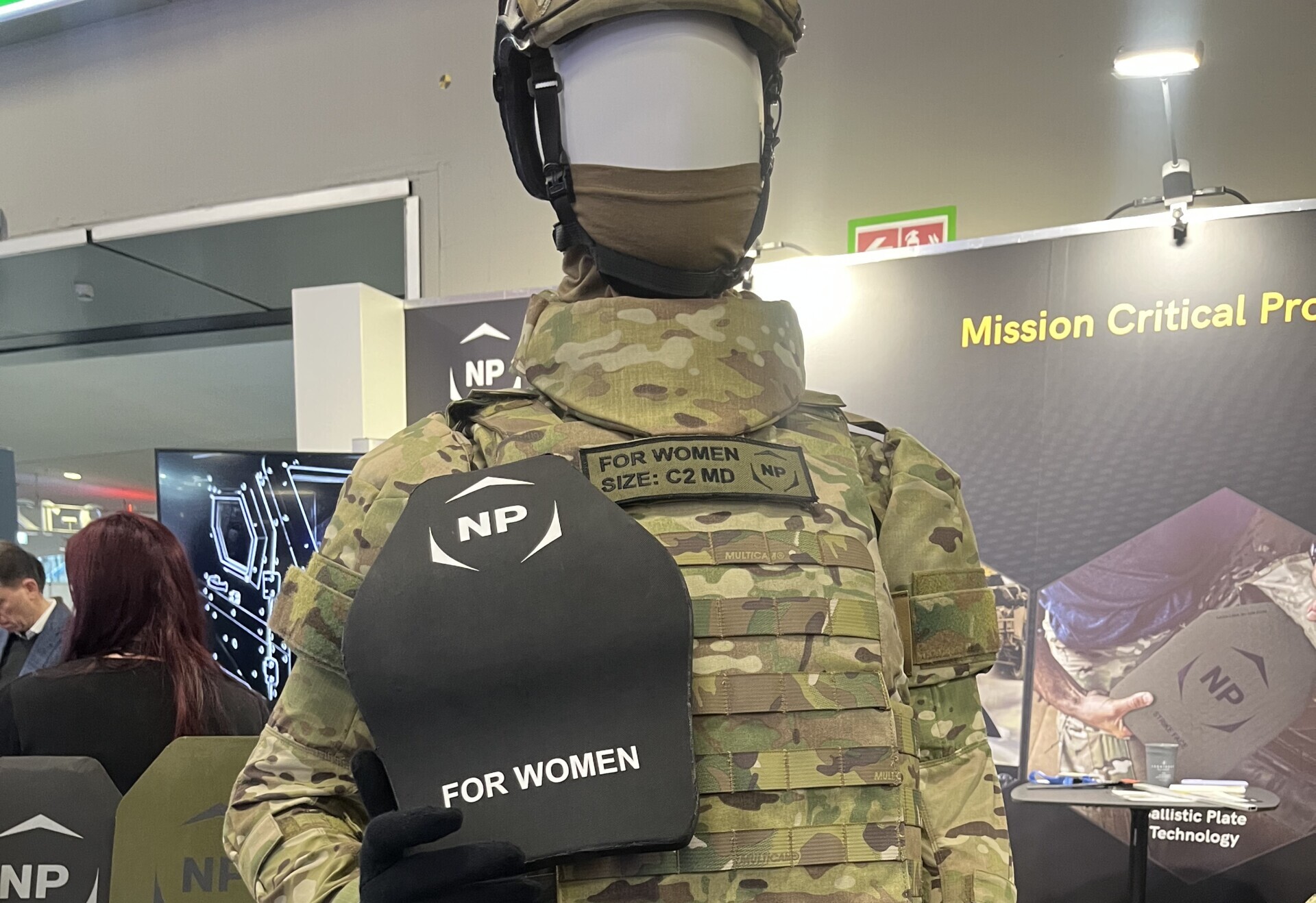
“Instead of the industry standard curvature of a hard armour plate, we’ve developed a range of curvatures that fit women’s breast volumes, and alongside that, optimise the overall length and width of the plates to fit women’s proportions better,” explained Senior Project Engineer Seren White.
The development was ultimately data-driven. Using the UK Defence Anthropometric Data Survey 2024, alongside Canadian and US datasets, the engineering team mapped how female body dimensions scale in three dimensions rather than two, making the process of plate creation more complex.
The result their team came up with was a matrix-based sizing approach. “There’s nine front plates. So, there are three curvatures and then three cuts,” Grieve noted. Importantly, torso size and breast volume are treated independently. “Just because you’re bigger or smaller in the breast area, does not mean you’ve got a bigger or smaller torso, right? So that’s why there’s almost a matrix of sizes.”
Women all over the world are familiar to and struggle with the catastrophe that is ‘breast sizing,’ which can involve a plethora of measurements that don’t even seem related to each other. Even after spending egregious amounts of time trying to find the right size, frequently the results are pretty sub par. NP Aerospace has simplified a process that’s been frankly exhausting and lacking internal consistency.
Ballistic Validation Across Complex Geometry
Curving a hard armor plate introduces engineering challenges, particularly regarding ballistic integrity across varying surface geometries.
“We’ve certainly learned that you need to test all areas of the plate in terms of the ballistic performance,” White said. Testing has been divided into three zones: the upper breast curvature, the central region, and the lower convex curve. This ensures that all zones are covered, especially where female bodies differ from men’s and can thus be endangered when wearing male plates.
The program is already under operational contract. NP Aerospace is delivering 2,000 sets of body armor to Ukraine under a UK MOD agreement. The contract is split evenly between rifle-protected (NIJ Level III equivalent) and armor-piercing (NIJ Level IV equivalent) systems.
“We’ve shot hundreds of plates already,” White confirmed, adding that the Level III trials are complete, while Level IV testing is nearing conclusion. According to the team, results have been “extremely positive,” with all required performance characteristics met.
The 3D Coverage Problem
A key driver behind the project is measurable ballistic vulnerability caused by ill-fitting plates.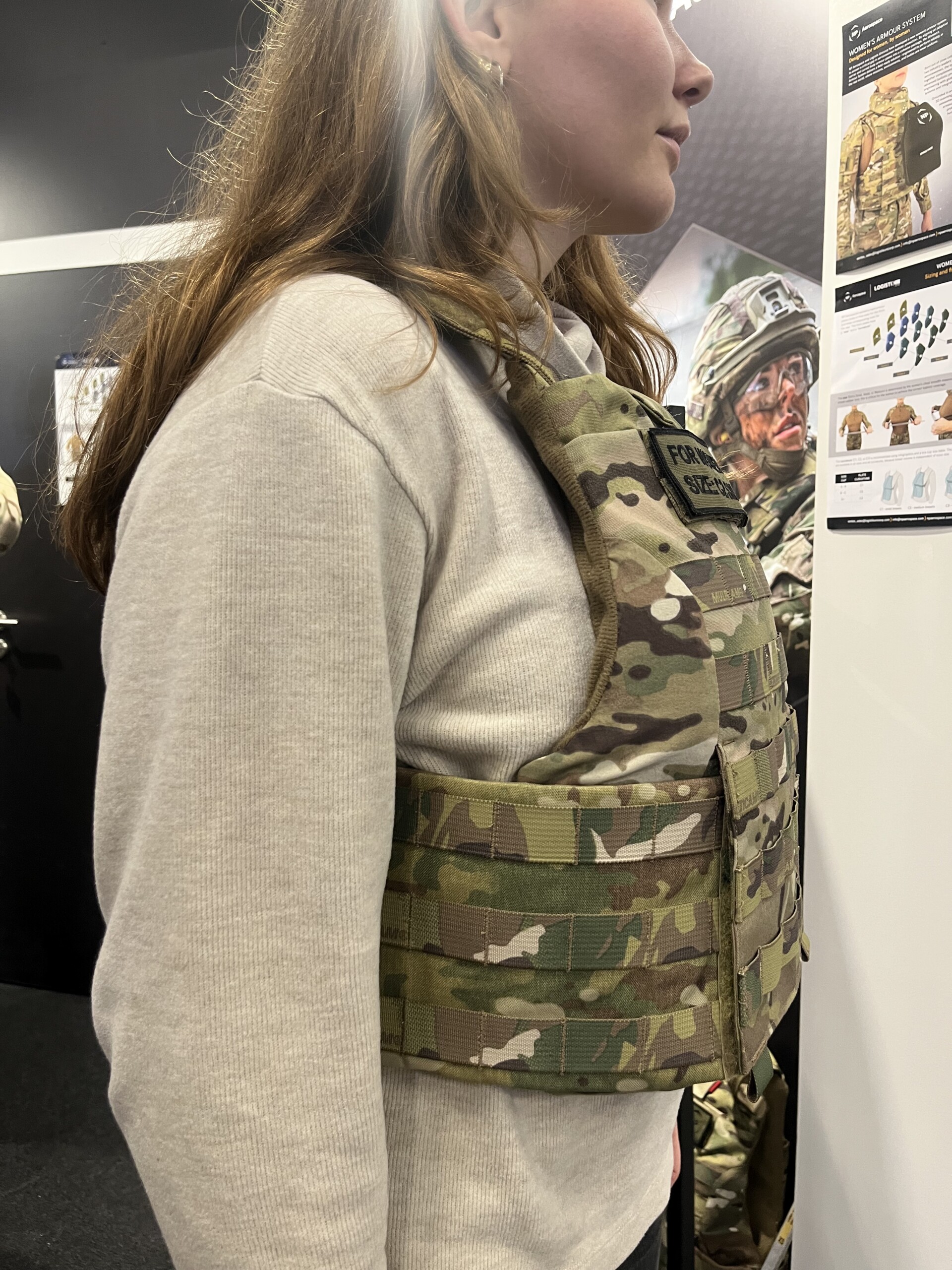
The UK’s Defence Science and Technology Laboratory (DSTL) uses a digital Coverage Armour Tool (COAT) to assess protection levels. However, the tool is currently based solely on male body geometry. In the absence of a female equivalent, NP Aerospace conducted its own modeling based on anthropometric datasets.
“In doing that work, we believe improving how a hard plate fits your form has a direct impact on the effective coverage. In one model, a curved plate provides 17% more coverage than ESAPI at 45°,” Grieve stated. The issue lies in three-dimensional fit. “If I hold that to my body… because of my breast volume, I can’t hold it flush with my torso,” she explained. While 2D frontal coverage may appear acceptable, top-down and angled threats expose protection gaps.
Integrating Soft and Hard Armor
NP Aerospace also addressed the interaction between hard plates and soft armor systems. The company emphasized material “drape-ability” in soft armor selection to ensure it complements the curved hard plates.
“What we’ve seen a lot is people doing women-specific vests or soft armour, but then putting a flat plate in there, which then takes away from the benefits,” Grieve explained.
Planar soft armor constructions can struggle to curve in multiple dimensions, potentially creating side gaps. The company describes its development approach as a “spiral update programme,” combining ballistic trials with wearer evaluations.
“That human factors element is really hard to assess until you have the system as a whole—carrier, soft armour and hard armour plate,” White explained.
From Ukraine to Broader Adoption?
The Ukraine contract marks the product’s first operational deployment. However, NP Aerospace is already positioning the system for wider adoption, including potential UK military and law enforcement applications.
“We’re in the Houses of Parliament, for example, this week with all of these systems in the UK, trying to look at could we bring this in for UK service personnel,” Grieve said.
A Structural Shift in Personal Protection
Female integration into military and law enforcement roles continues to accelerate globally. Yet protective equipment has often lagged behind operational reality. NP Aerospace’s approach, grounded in anthropometric data, geometric redesign, and ballistic validation, signals a structural shift rather than an incremental adjustment.
I had the privilege of fitting the plates myself at this show. I was taken through the sizing process, using a tool explained by White to be easy enough that women in conflict zones can fit themselves with little confusion. I was given a male plate in the carrier first, in order to have a better idea of the difference. It was truly baffling, the sizes of the gaps in the chest and armpit area that could be easily targeted. Besides the obvious dangers, it was uncomfortable.
White and Grieve agreed that it’s truly incredible, not only the bravery of women in combat, but that they’re able to carry out their roles while wearing a plate that’s so difficult to move in.
When putting on the female plate, the difference was night and day. It was snug against my torso with no gaps, meeting the height of my sternum. I’m overjoyed that so many women in Ukraine are getting proper hard armor and can focus solely on their jobs rather than poor fitting armor.
If adoption expands beyond Ukraine, the program could represent a new benchmark for female-specific armor design. One defined not by adaptation, but by intentional, principled engineering.