

As European governments reassess defense spending and supply chain resilience, raw material suppliers are increasingly positioning themselves at the center of procurement discussions. At Enforce Tac 2026, BodyArmorNews had the pleasure of speaking with Richard Gunters of Dyneema. The Regional Business Manager and Sales Director highlighted not only its latest ultra-high molecular weight polyethylene (UHMWPE) innovations and ballistic fiber but also the strategic importance of maintaining fiber production within NATO member states.
From Powder to UD: A Fully Integrated NATO Supply Chain
Dyneema produces UHMWPE fiber and Uni-Directional (UD) materials used in ballistic applications, with manufacturing operations in both the Netherlands and the United States. According to Gunters, strategic autonomy is central to the company’s message.
“What we always emphasize is the importance of strategic autonomy, so producing on European soil, but also in the US,” he said. “So you’re not dependent on far away supplies.”
By controlling the full process—“we make everything from powder… to fiber to UD. We do everything in the Netherlands or in the US”—Dyneema positions itself as less vulnerable to global shipping disruptions or geopolitical instability. In an environment shaped by supply chain fragmentation, this vertically integrated NATO footprint is presented as a strategic differentiator.
Letter of Intent Reinforces Dutch High-Performance Fiber Ecosystem
A recent letter of intent signed between Dyneema and Teijin Aramid aims to strengthen the Netherlands’ position in high-performance ballistic fibers. The objective is not to prescribe brands, but to influence procurement frameworks toward NATO-sourced materials.
The Netherlands occupies a unique position in this market. “In the world of strong fibers, there’s two types of aramid and there’s two types of polyethylene produced within NATO member states… so there’s four in total and two of those four come from the Netherlands,” Gunters noted. This concentration of capability has placed Dutch fiber producers high on the national defense agenda.
What we do see is that within NATO member states and within the EU, non-NATO or non-European fibers and UD’s are being used without the end-user knowing the source of UD and (more important), fiber. It is cynical, but by doing this, countries make use of a vulnerable supply chain and might end up in a situation of not getting ballistic protective products. It is also harming the companies that make UD and fiber ‘’in the West.’’
Third-Generation Fiber and Continued Innovation
Innovation remains a central pillar of Dyneema’s strategy. “Two years ago, we launched our third generation fiber,” Gunters said, referencing the company’s latest platform, which is now gaining commercial traction.
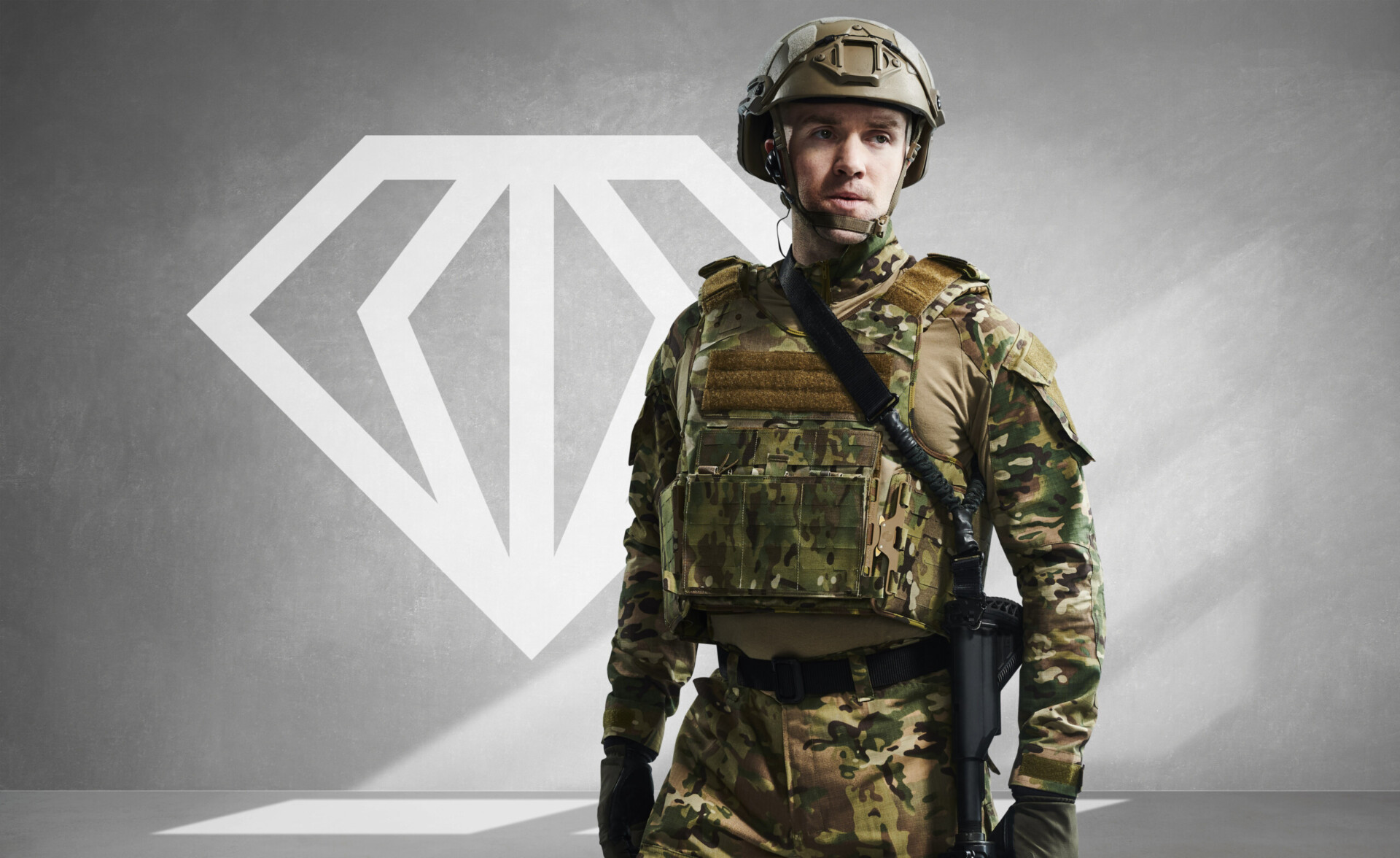
Material evolution has already reshaped certain product categories. Gunters observed that within NATO, helmet construction has shifted markedly. “Maybe 10 years ago… the majority share of helmets… was aramid. It’s now predominantly Dyneema.” The weight saving is double digit whereas the ballistic protection also increases.
Lightweight plates similarly favor polyethylene, while vehicle armor remains more traditionally aramid-based. Unless weight is really critical and overmatch protection is required. Aerospace applications such as helicopter armor, where weight is critical, continue to adopt polyethylene solutions.
Hybridisation and Market Evolution
Looking ahead, Gunters sees continued growth for polyethylene but acknowledges the role of hybrid systems.
“In some cases, yes, you need a stiff material combining with a strong material,” he explained. “Dyneema then being a strong material and the stiff material can be glass or in some cases aramid.” An example would be full composite vehicle hulls.
Rather than a binary competition between fiber families, the market appears increasingly application-driven, with performance requirements dictating material combinations.
Capacity, Demand Signals, and Defence Spending
Dyneema increased production capacity in 2019 after demand exceeded supply. However, further scaling depends on clearer government investment signals.
“You can do a lot with debottlenecking in your factory but it’s not enough. In the end, you need to scale up production,” Gunters said.
While discussions around increased defense spending continue, suppliers require concrete commitments to soldier protection programs. “If you get clear signals that governments are willing to spend more on helmets and body armor, then it’s also worthwhile to invest,” he noted.
Sustainability and Carbon Footprint
On sustainability, Dyneema positions itself as comparatively efficient among high-performance fiber manufacturers.
“When you look at our competitors of ultra-high molecular weight polyethylenes but also of the aramids, I dare to say that we have the lowest carbon footprint,” Gunters stated .
However, meaningful recycling remains a challenge. “We’ve got dedicated people working on it, but we’re not there yet,” he acknowledged, adding that large-scale recycling progress will likely require co-investment and policy incentives.
Strategic Positioning at the Fiber Level
As global supply chains become more complex and geopolitical considerations shape procurement frameworks, Dyneema is aligning its message with NATO-based sourcing, vertical integration, and continuous innovation.
In Gunters’ view, resilience begins upstream, ensuring that the fibers forming the backbone of helmets and body armor are secure, scalable, and produced within trusted territories.
In a market increasingly defined by strategic autonomy, the future of personal protection may depend as much on where fibers are made as on how they perform.